Available Questions 48 found Page 1 of 3
Standalone Questions
#1840
Mathematics
Linear Programming
MCQ_SINGLE
APPLY
2026
AISSCE(Board Exam)
KNOWLEDGE
1 Marks
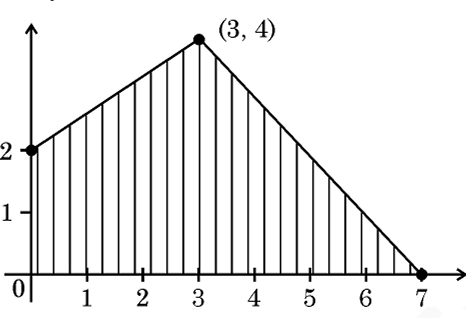 The feasible region of a linear programming problem with objective function Z = 5x + 7y is shown below :
 The maximum value of Z - minimum value of Z is
(A) 8
(B) 29
(C) 35
(D) 43
Key:
Sol:
Sol:
#1839
Mathematics
Linear Programming
MCQ_SINGLE
APPLY
2026
AISSCE(Board Exam)
KNOWLEDGE
1 Marks
The degree of an objective function of a linear programming problem is
(A) 0
(B) 1
(C) 2
(D) Any natural number
Key: B
Sol:
Sol:
#1836
Mathematics
Linear Programming
SA
APPLY
2026
AISSCE(Board Exam)
KNOWLEDGE
3 Marks
Solve the following linear programming problem graphically :
Minimize $Z = 13x - 15y$
Subject to constraints
$$x + y \leq 7,$$
$$2x - 3y + 6 \geq 0,$$
$$x \geq 0, y \geq 0$$
Minimize $Z = 13x - 15y$
Subject to constraints
$$x + y \leq 7,$$
$$2x - 3y + 6 \geq 0,$$
$$x \geq 0, y \geq 0$$
Key:
Sol:
Sol:
#1829
Mathematics
Linear Programming
LA
APPLY
2026
AISSCE(Board Exam)
Competency
5 Marks
Solve the following Linear Programming Problem graphically: Maximise $Z=600x+400y$ subject to the constraints $x+2y\le12$, $2x+y\le12$, $4x+5y\ge20$, $x, y\ge0$
Key:
Sol:
Sol:
#1799
Mathematics
Linear Programming
SA
2026
AISSCE(Board Exam)
KNOWLEDGE
3 Marks
Solve the following Linear Programming Problem graphically: Maximize $Z=\frac{2x}{5}+\frac{3y}{10}$ subject to constraints $2x+y\le 1000$, $x+y\le 800$, $x, y \ge 0$.
Key:
Sol:
Sol:
#1798
Mathematics
Linear Programming
SA
2026
AISSCE(Board Exam)
KNOWLEDGE
3 Marks
Solve the following Linear Programming Problem graphically: Maximise $Z=200x+120y$ subject to the constraints $x+y\le 300$, $3x+y\le 600$, $x-y\ge -100$, $x,y\ge 0$
Key:
Sol:
Sol:
#1797
Mathematics
Linear Programming
SA
2026
AISSCE(Board Exam)
KNOWLEDGE
3 Marks
Solve the following linear programming problem graphically: Maximize $Z=10500x+9000y$ Subject to constraints $x+y \le 50$, $2x+y \le 80$, $x, y \ge 0$
Key:
Sol:
Sol:
#1737
Mathematics
Linear Programming
MCQ_SINGLE
REMEMBER
2026
AISSCE(Board Exam)
KNOWLEDGE
1 Marks
The region represented by the system of inequations $3x+y\ge 3$, $2x-y\ge -5$, $x, y\ge 0$ is:
(A) unbounded in $1^{st}$ quadrant
(B) bounded in $1^{st}$ quadrant
(C) unbounded in $2^{nd}$ quadrant
(D) bounded in $2^{nd}$ quadrant
Key: B
Sol:
Sol:
#1736
Mathematics
Linear Programming
MCQ_SINGLE
APPLY
2026
AISSCE(Board Exam)
KNOWLEDGE
1 Marks
In a linear programming problem, the linear function which has to be maximized or minimized is called
(A) a feasible function
(B) an objective function
(C) an optimal function
(D) a constraint
Key: B
Sol:
Sol:
#1735
Mathematics
Linear Programming
MCQ_SINGLE
2026
AISSCE(Board Exam)
KNOWLEDGE
1 Marks
For the feasible region shown below, the non-trivial constraints of the linear programming problem are
(A) $x+y \le 5$, $x+3y \le 9$
(B) $x+y \le 5$, $x+3y \ge 9$
(C) $x+y \ge 5$, $x+3y \le 9$
(D) $x+y \ge 5$, $3x+y \le 9$
Key:
Sol:
Sol:
#1734
Mathematics
Linear Programming
MCQ_SINGLE
2026
AISSCE(Board Exam)
KNOWLEDGE
1 Marks
In the graph, the feasible region representing the Linear Programming Problem for maximising objective function $Z=px+qy$, $p, q>0$ is shaded. If all points on segment AB give max (Z), then which of the following is true? [Graph shows A at (0, 5) and B at (3, 4)]
(A) $p=2q$
(B) $p=3q$
(C) $q=3p$
(D) $q=2p$
Key:
Sol:
Sol:
#1733
Mathematics
Linear Programming
MCQ_SINGLE
APPLY
2026
AISSCE(Board Exam)
Competency
1 Marks
The corner points of the feasible region determined by the system of linear constraints are (0,0), (0, 40), (20, 40), (60, 20) and (60, 0). If the objective function of an LPP is $Z=4x+3y$, then the maximum value is :
(A) 200
(B) 300
(C) 240
(D) 120
Key: B
Sol:
Sol:
#1507
Mathematics
Linear Programming
SA
APPLY
KNOWLEDGE
3 Marks
Solve the following linear programming problem graphically :
Minimize
$Z = 13x – 15y$
Subject to constraints
$x + y \le 7$,
$2x – 3y + 6 \le 0$,
$x \ge 0, y \ge 0$
Minimize
$Z = 13x – 15y$
Subject to constraints
$x + y \le 7$,
$2x – 3y + 6 \le 0$,
$x \ge 0, y \ge 0$
Key:
Sol:
Sol:
#1478
Mathematics
Linear Programming
SA
REMEMBER
2025
AISSCE(Board Exam)
KNOWLEDGE
3 Marks
In the Linear Programming Problem for objective function $Z=18x+10y$ subject to constraints $4x+y\ge20$, $2x+3y\ge30$, $x,y\ge0$ find the minimum value of Z.
Key:
Sol:
Sol:
#1469
Mathematics
Linear Programming
VSA
2025
AISSCE(Board Exam)
2 Marks
In a Linear Programming Problem, the objective function $Z=5x+4y$ needs to be maximised under constraints $3x+y\le6$, $x\le1$, $x, y\ge0$. Express the LPP on the graph and shade the feasible region and mark the corner points.
Key:
Sol:
Sol:
#1455
Mathematics
Linear Programming
SA
REMEMBER
2025
AISSCE(Board Exam)
Competency
3 Marks
Consider the Linear Programming Problem, where the objective function $Z=(x+4y)$ needs to be minimized subject to constraints $2x+y\ge1000$, $x+2y\ge800$, $x,y\ge0$. Draw a neat graph of the feasible region and find the minimum value of Z.
Key:
Sol:
Sol:
#1432
Mathematics
Linear Programming
SA
REMEMBER
2025
AISSCE(Board Exam)
KNOWLEDGE
3 Marks
In the Linear Programming Problem (LPP), find the point/points giving maximum value for $Z=5x+10y$ subject to constraints $x+2y\le120$, $x+y\ge60$, $x-2y\ge0$, $x, y\ge0$.
Key:
Sol:
Sol:
#1414
Mathematics
Linear Programming
SA
REMEMBER
2025
AISSCE(Board Exam)
Competency
3 Marks
Solve the following Linear Programming Problem using graphical method: Maximise $Z=100x+50y$ subject to the constraints $3x+y\le600$, $x+y\le300$, $y\le x+200$, $x\ge0$, $y\ge0$.
Key:
Sol:
Sol:
#1387
Mathematics
Linear Programming
SA
UNDERSTAND
2025
AISSCE(Board Exam)
Competency
3 Marks
Solve the following linear programming problem graphically: Minimise $Z=x-5y$ subject to the constraints: $x-y\ge0$, $-x+2y\ge2$, $x\ge3$, $y\le4$, $y\ge0$.
Key:
Sol:
Sol:
#1363
Mathematics
Linear Programming
SA
REMEMBER
2025
AISSCE(Board Exam)
KNOWLEDGE
3 Marks
Solve the following linear programming problem graphically: Maximise $Z=x+2y$ Subject to the constraints: $x-y\ge0$, $x-2y\ge-2$, $x\ge0$, $y\ge0$.
Key:
Sol:
Sol: