Available Questions 850 found Page 41 of 43
Standalone Questions
#599
Mathematics
Continuity and Differentiability
MCQ_SINGLE
APPLY
2025
AISSCE(Board Exam)
Competency
1 Marks
If f(x)=∣x∣+∣x−1∣, then which of the following is correct?
(A) f(x) is both continuous and differentiable, at x=0 and x=1.
(B) f(x) is differentiable but not continuous, at x=0 and x=1.
(C) f(x) is continuous but not differentiable, at x=0 and x=1.
(D) f(x) is neither continuous nor differentiable, at x=0 and x=1.
Key: C
Sol:
Sol:
#598
Mathematics
Continuity and Differentiability
MCQ_SINGLE
APPLY
2025
AISSCE(Board Exam)
KNOWLEDGE
1 Marks
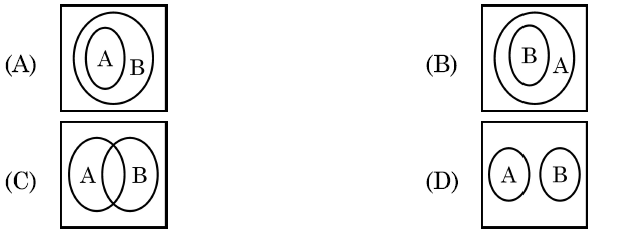 If A denotes the set of continuous functions and B denotes set of differentiable functions, then which of the following depicts the correct relation between set A and B ?
(A) A
(B) B
(C) C
(D) D
Key: B
Sol:
Sol:
Every differentiable function is continuous
#597
Mathematics
Continuity and Differentiability
MCQ_SINGLE
APPLY
2025
AISSCE(Board Exam)
KNOWLEDGE
1 Marks
If \(f(x)=\begin{cases}3x-2,&0 \lt x\le 1\\ 2x^{2}+ax,&1\lt x\lt 2\end{cases}\) is continuous for \(x\in(0,2)\), then a is equal to:
(A) -4
(B) \(-\frac{7}{2}\)
(C) -2
(D) -1
Key: D
Sol:
Sol:
...
#596
Mathematics
Continuity and Differentiability
MCQ_SINGLE
UNDERSTAND
2025
AISSCE(Board Exam)
KNOWLEDGE
1 Marks
The function f defined by \(f(x)=\begin{cases}x,&if~x\le1\\ 5,&if~x>1\end{cases}\) is not continuous at:
(A) \(x=0\)
(B) \(x=1\)
(C) \(x=2\)
(D) \(x=5\)
Key: B
Sol:
Sol:
for x=1, LHL=1 and RHL=5
#595
Mathematics
Continuity and Differentiability
MCQ_SINGLE
APPLY
2025
AISSCE(Board Exam)
KNOWLEDGE
1 Marks
If \(f(x)=\begin{cases}\frac{\sin^{2}ax}{x^{2}},&x\ne0\\ 1,&x=0\end{cases}\) is continuous at \(x=0\), then the value of a is:
(A) 1
(B) -1
(C) \(\pm1\)
(D) 0
Key:
Sol:
Sol:
#594
Mathematics
Continuity and Differentiability
MCQ_SINGLE
APPLY
2025
AISSCE(Board Exam)
KNOWLEDGE
1 Marks
If \(f(x)=\{[x],x\in R\}\) is the greatest integer function, then the correct statement is:
(A) f is continuous but not differentiable at \(x=2\).
(B) f is neither continuous nor differentiable at \(x=2\).
(C) f is continuous as well as differentiable at \(x=2\).
(D) f is not continuous but differentiable at \(x=2\).
Key:
Sol:
Sol:
#593
Mathematics
Continuity and Differentiability
MCQ_SINGLE
UNDERSTAND
2025
AISSCE(Board Exam)
Competency
1 Marks
If \(f(x)=\begin{cases}\frac{\log(1+ax)+\log(1-bx)}{x},&for~x\ne0\\ k&,for~x=0\end{cases}\) is continuous at \(x=0\), then the value of k is:
(A) a
(B) \(a+b\)
(C) \(a-b\)
(D) b
Key: C
Sol:
Sol:
#592
Mathematics
Continuity and Differentiability
MCQ_SINGLE
APPLY
2025
AISSCE(Board Exam)
Competency
1 Marks
If \( f(x) = \begin{cases} 1, & \text{if } x \leq 3 \\ ax + b, & \text{if } 3 < x < 5 \\ 7, & \text{if } x \geq 5 \end{cases} \) is continuous for all real numbers, then find the values of \(a\) and \(b\):
(A) \(a=3\), \(b=-8\)
(B) \(a=3\), \(b=8\)
(C) \(a=-3\), \(b=-8\)
(D) \(a=-3\), \(b=8\)
Key:
Sol:
Sol:
#591
Mathematics
Continuity and Differentiability
MCQ_SINGLE
UNDERSTAND
2024
AISSCE(Board Exam)
KNOWLEDGE
1 Marks
A function \(f(x)=|1-x+|x||\) is:
(A) discontinuous at \(x=1\) only
(B) discontinuous at \(x=0\) only
(C) discontinuous at \(x=0,1\)
(D) continuous everywhere
Key:
Sol:
Sol:
#590
Mathematics
Continuity and Differentiability
MCQ_SINGLE
REMEMBER
2024
AISSCE(Board Exam)
KNOWLEDGE
1 Marks
For what value of k, the function given below is continuous at \(x=0\) ? \(f(x)=\begin{cases}\frac{\sqrt{4+x}-2}{x},&x\ne0\\ k,&x=0\end{cases}\)
(A) 0
(B) \(\frac{1}{4}\)
(C) 1
(D) 4
Key: B
Sol:
Sol:
#589
Mathematics
Inverse Trigonometric Functions
MCQ_SINGLE
APPLY
2025
AISSCE(Board Exam)
Competency
1 Marks
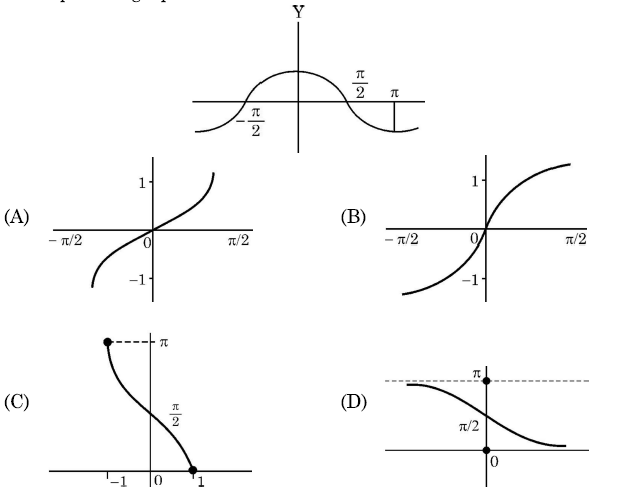 The Graph of a trigonomertic finction is as shown. Which of the following will represent graphs of its inverse?
(A) A
(B) B
(C) C
(D) D
Key: C
Sol:
Sol:
#588
Mathematics
Inverse Trigonometric Functions
MCQ_SINGLE
UNDERSTAND
2025
AISSCE(Board Exam)
KNOWLEDGE
1 Marks
If \(y=\sin^{-1}x\), \(-1 \le x \le 0\), then the range of y is
(A) \((\frac{-\pi}{2}, 0)\)
(B) \([\frac{-\pi}{2}, 0]\)
(C) \([\frac{-\pi}{2}, 0)\)
(D) \((\frac{-\pi}{2}, 0]\)
Key: B
Sol:
Sol:
Given \(y=\sin^{-1}x\) with \(-1 \le x \le 0\).
For the principal branch of the inverse sine function,
\[
-\frac{\pi}{2} \le \sin^{-1}x \le \frac{\pi}{2}.
\]
At the endpoints:
\[
x=-1 \;\Rightarrow\; y=\sin^{-1}(-1)=-\frac{\pi}{2},
\]
\[
x=0 \;\Rightarrow\; y=\sin^{-1}(0)=0.
\]
Since \(\sin^{-1}x\) is increasing on \([-1,1]\), the range is
\[
\boxed{-\frac{\pi}{2} \le y \le 0}.
\]
#587
Mathematics
Inverse Trigonometric Functions
MCQ_SINGLE
REMEMBER
2025
AISSCE(Board Exam)
KNOWLEDGE
1 Marks
The principal value of \(\sin^{-1}(\sin(-\frac{10\pi}{3}))\) is:
(A) \(-\frac{2\pi}{3}\)
(B) \(-\frac{\pi}{3}\)
(C) \(\frac{\pi}{3}\)
(D) \(\frac{2\pi}{3}\)
Key: C
Sol:
Sol:
#586
Mathematics
Inverse Trigonometric Functions
MCQ_SINGLE
REMEMBER
2025
AISSCE(Board Exam)
KNOWLEDGE
1 Marks
The principal value of \(\cot^{-1}(-\frac{1}{\sqrt{3}})\) is:
(A) \(-\frac{\pi}{3}\)
(B) \(-\frac{2\pi}{3}\)
(C) \(\frac{\pi}{3}\)
(D) \(\frac{2\pi}{3}\)
Key: D
Sol:
Sol:
#585
Mathematics
Inverse Trigonometric Functions
MCQ_SINGLE
APPLY
2025
AISSCE(Board Exam)
KNOWLEDGE
1 Marks
\([\sec^{-1}(-\sqrt{2})-\tan^{-1}(\frac{1}{\sqrt{3}})]\) is equal to:
(A) \(\frac{11\pi}{12}\)
(B) \(\frac{5\pi}{12}\)
(C) \(-\frac{5\pi}{12}\)
(D) \(\frac{7\pi}{12}\)
Key: D
Sol:
Sol:
#584
Mathematics
Inverse Trigonometric Functions
MCQ_SINGLE
APPLY
2025
AISSCE(Board Exam)
Competency
1 Marks
If \(\tan^{-1}(x^{2}-y^{2})=a\), where 'a' is a constant, then \(\frac{dy}{dx}\) is:
(A) \(\frac{x}{y}\)
(B) \(-\frac{x}{y}\)
(C) \(\frac{a}{x}\)
(D) \(\frac{a}{y}\)
Key: A
Sol:
Sol:
#583
Mathematics
Inverse Trigonometric Functions
MCQ_SINGLE
APPLY
2025
AISSCE(Board Exam)
KNOWLEDGE
1 Marks
Domain of \(f(x)=\cos^{-1}x+\sin x\) is :
(A) R
(B) \((-1, 1)\)
(C) \([-1, 1]\)
(D) \([-\pi/2, \pi/2]\)
Key: C
Sol:
Sol:
#576
Mathematics
Relations and Functions
MCQ_SINGLE
UNDERSTAND
2025
AISSCE(Board Exam)
KNOWLEDGE
1 Marks
For real x, let \(f(x)=x^{3}+5x+1\). Then:
(A) f is one-one but not onto on R
(B) f is onto on R but not one-one
(C) f is one-one and onto on R
(D) f is neither one-one nor onto on R
Key: C
Sol:
Sol:
#575
Mathematics
Relations and Functions
MCQ_SINGLE
UNDERSTAND
2025
AISSCE(Board Exam)
KNOWLEDGE
1 Marks
If \(f:N\rightarrow W\) is defined as \(f(n)=\begin{cases}\frac{n}{2},&if~n~is~even\\ 0,&if~n~is~odd\end{cases}\), then f is:
(A) injective only
(B) surjective only
(C) a bijection
(D) neither surjective nor injective
Key: B
Sol:
Solution
Question: If f : N → W is defined by
f(n) = { n/2, if n is even; 0, if n is odd }, then f is:
A. injective only B. surjective only C. a bijection D. neither surjective nor injective
Solution:
Injective (one–one): By definition, f is injective if f(x₁)=f(x₂) ⇒ x₁=x₂. Here, f(1)=0, f(3)=0, f(5)=0. Different natural numbers have the same image, hence f is not injective.
Surjective (onto): A function f : N → W is surjective if for every y ∈ W, there exists n ∈ N such that f(n)=y. For y=0, choose any odd n. For y≥1, choose n=2y ⇒ f(2y)=y. Thus every element of W has a preimage, so f is surjective.
Conclusion: The function is surjective but not injective. Correct option: B
Sol:
A. injective only B. surjective only C. a bijection D. neither surjective nor injective
Solution:
Injective (one–one): By definition, f is injective if f(x₁)=f(x₂) ⇒ x₁=x₂. Here, f(1)=0, f(3)=0, f(5)=0. Different natural numbers have the same image, hence f is not injective.
Surjective (onto): A function f : N → W is surjective if for every y ∈ W, there exists n ∈ N such that f(n)=y. For y=0, choose any odd n. For y≥1, choose n=2y ⇒ f(2y)=y. Thus every element of W has a preimage, so f is surjective.
Conclusion: The function is surjective but not injective. Correct option: B
#574
Mathematics
Relations and Functions
MCQ_SINGLE
APPLY
2024
AISSCE(Board Exam)
KNOWLEDGE
1 Marks
A function \(f:R_{+}\rightarrow R\) (where \(R_{+}\) is the set of all non-negative real numbers) defined by \(f(x)=4x+3\) is:
(A) one-one but not onto
(B) onto but not one-one
(C) both one-one and onto
(D) neither one-one nor onto
Key: A
Sol:
Solution
Question:
A function f : R+ → R (where R+ is the set of all non-negative real numbers) is defined by
f(x) = 4x + 3. Then f is:
(A) one–one but not onto (B) onto but not one–one (C) both one–one and onto (D) neither one–one nor onto
Solution:
One–one: Let f(x₁) = f(x₂). Then 4x₁ + 3 = 4x₂ + 3 ⇒ x₁ = x₂. Hence, f is one–one.
Onto: For f to be onto, for every y ∈ R there must exist x ∈ R+ such that y = 4x + 3 ⇒ x = (y − 3)/4. Since x ≥ 0, we must have y ≥ 3. Thus, values y < 3 are not obtained. Hence, f is not onto R.
Conclusion: The function is one–one but not onto.
Correct option: (A)
Sol:
(A) one–one but not onto (B) onto but not one–one (C) both one–one and onto (D) neither one–one nor onto
Solution:
One–one: Let f(x₁) = f(x₂). Then 4x₁ + 3 = 4x₂ + 3 ⇒ x₁ = x₂. Hence, f is one–one.
Onto: For f to be onto, for every y ∈ R there must exist x ∈ R+ such that y = 4x + 3 ⇒ x = (y − 3)/4. Since x ≥ 0, we must have y ≥ 3. Thus, values y < 3 are not obtained. Hence, f is not onto R.
Conclusion: The function is one–one but not onto.
Correct option: (A)