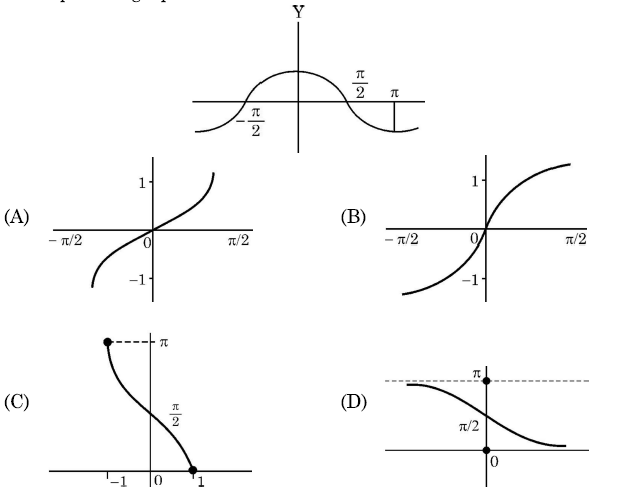
 The Graph of a trigonomertic finction is as shown. Which of the following will represent graphs of its inverse?
Detailed Solution
Step 1: Understanding Inverse Functions and Their Graphs
The graph of the inverse of a function $f(x)$ is obtained by reflecting the graph of $f(x)$ about the line $y = x$. This means that if a point $(a, b)$ lies on the graph of $f(x)$, then the point $(b, a)$ lies on the graph of its inverse.
Step 2: Visualizing the Reflection
Imagine the given trigonometric function's graph being reflected across the line $y = x$. The x-axis becomes the y-axis and vice versa. The general shape of the graph will change accordingly.
Step 3: Analyzing the Options (Without Visuals)
Without the actual graphs (A, B, C, D), it's impossible to definitively choose the correct one. However, we can infer some characteristics the inverse graph should have:
- If the original function has a range of $[a, b]$, the inverse will have a domain of $[a, b]$.
- If the original function has a domain restriction to be invertible, the inverse will reflect that in its range.
Since we don't have the graphs, we cannot proceed further.
Final Answer: Cannot determine without the graphs.
AI generated content. Review strictly for academic accuracy.