Available Questions 783 found Page 37 of 40
Standalone Questions
#612
Mathematics
Applications of Derivatives
MCQ_SINGLE
UNDERSTAND
2024
AISSCE(Board Exam)
KNOWLEDGE
1 Marks
Let \(f(x)\) be a continuous function on [a, b] and differentiable on (a, b). Then, this function \(f(x)\) is strictly increasing in (a, b) if
(A) \(f^{\prime}(x)\lt;0\), \(\forall x\in(a,b)\)
(B) \(f^{\prime}(x)\gt;0\), \(\forall x\in(a,b)\)
(C) \(f^{\prime}(x)=0\), \(\forall x\in(a,b)\)
(D) \(f(x)\gt;0\), \(\forall x\in(a,b)\)
Key:
Sol:
Sol:
The solution is as follows:
**Step 1:** Recall the relationship between the derivative of a function and its increasing/decreasing behavior.
A function is strictly increasing on an interval if its derivative is strictly positive on that interval.
**Step 2:** Analyze the given options in light of this relationship.
Option A states \(f^{\prime}(x) \lt 0\), which implies the function is strictly decreasing.
Option B states \(f^{\prime}(x) \gt 0\), which implies the function is strictly increasing.
Option C states \(f^{\prime}(x) = 0\), which implies the function is constant.
Option D is about the function's value, not its rate of change.
**Step 3:** Conclude based on the definition of a strictly increasing function.
For \(f(x)\) to be strictly increasing in \((a, b)\), its derivative \(f^{\prime}(x)\) must be greater than 0 for all \(x\) in \((a, b)\).
The final answer is $\boxed{B}$.
#611
Mathematics
Applications of Derivatives
MCQ_SINGLE
APPLY
2024
AISSCE(Board Exam)
KNOWLEDGE
1 Marks
The function \(f(x)=x^{3}-3x^{2}+12x-18\) is:
(A) strictly decreasing on R
(B) strictly increasing on R
(C) neither strictly increasing nor strictly decreasing on R
(D) strictly decreasing on \((-\infty, 0)\)
Key:
Sol:
Sol:
Here's the step-by-step solution:
1. **Find the first derivative of the function:**
$f'(x) = \frac{d}{dx}(x^3 - 3x^2 + 12x - 18) = 3x^2 - 6x + 12$.
2. **Analyze the sign of the first derivative:** The derivative is a quadratic function. To determine its sign, we can find its discriminant. The discriminant of $ax^2 + bx + c$ is $b^2 - 4ac$. For $3x^2 - 6x + 12$, the discriminant is $(-6)^2 - 4(3)(12) = 36 - 144 = -108$.
3. **Interpret the discriminant:** Since the discriminant is negative and the leading coefficient (3) is positive, the quadratic $f'(x) = 3x^2 - 6x + 12$ is always positive for all real values of $x$.
4. **Conclude the function's behavior:** Because $f'(x) > 0$ for all $x \in \mathbb{R}$, the function $f(x)$ is strictly increasing on $\mathbb{R}$.
The final answer is $\boxed{B}$.
#610
Mathematics
Applications of Derivatives
MCQ_SINGLE
APPLY
2024
AISSCE(Board Exam)
Competency
1 Marks
If the sides of a square are decreasing at the rate of \(1.5~cm/s\) the rate of decrease of its perimeter is:
(A) \(1.5~cm/s\)
(B) \(6~cm/s\)
(C) \(3~cm/s\)
(D) \(2.25~cm/s\)
Key:
Sol:
Sol:
Let the side of the square be $s$.
The perimeter of the square is $P = 4s$.
We are given that the rate of decrease of the side is $\frac{ds}{dt} = -1.5~cm/s$.
We need to find the rate of decrease of its perimeter, which is $\frac{dP}{dt}$.
Differentiate the perimeter equation with respect to time $t$:
$\frac{dP}{dt} = \frac{d}{dt}(4s)$
$\frac{dP}{dt} = 4 \frac{ds}{dt}$
Substitute the given value of $\frac{ds}{dt}$:
$\frac{dP}{dt} = 4 (-1.5~cm/s)$
$\frac{dP}{dt} = -6~cm/s$
The rate of decrease of its perimeter is $6~cm/s$.
The final answer is $\boxed{6~cm/s}$.
#609
Mathematics
Applications of Derivatives
MCQ_SINGLE
APPLY
2024
AISSCE(Board Exam)
KNOWLEDGE
1 Marks
The function \(f(x)=kx-\sin~x\) is strictly increasing for
(A) \(k\gt1\)
(B) \(k\lt1\)
(C) \(k\gt-1\)
(D) \(k\lt-1\)
Key:
Sol:
Sol:
The solution proceeds as follows:
**Step 1: Find the derivative of the function.**
The derivative of \(f(x) = kx - \sin~x\) is \(f'(x) = k - \cos~x\).
**Step 2: Determine the condition for a strictly increasing function.**
For a function to be strictly increasing, its derivative must be strictly positive, i.e., \(f'(x) > 0\).
**Step 3: Apply the condition to the derivative.**
We need \(k - \cos~x > 0\) for all \(x\). This means \(k > \cos~x\) for all \(x\).
**Step 4: Find the maximum value of $\cos~x$.**
The maximum value of $\cos~x$ is 1.
**Step 5: Determine the condition for $k$.**
For \(k > \cos~x\) to hold for all \(x\), \(k\) must be greater than the maximum value of $\cos~x$. Therefore, \(k > 1\).
**Final Answer:**
The function \(f(x)=kx-\sin~x\) is strictly increasing for \(k\gt1\).
The final answer is $\boxed{k\gt1}$.
#608
Mathematics
Applications of Derivatives
MCQ_SINGLE
APPLY
2024
AISSCE(Board Exam)
KNOWLEDGE
1 Marks
The function \(f(x)=\frac{x}{2}+\frac{2}{x}\) has a local minima at x equal to:
(A) 2
(B) 1
(C) 0
(D) -2
Key:
Sol:
Sol:
#607
Mathematics
Applications of Derivatives
MCQ_SINGLE
APPLY
2024
AISSCE(Board Exam)
Competency
1 Marks
Given a curve \(y=7x-x^{3}\) and x increases at the rate of 2 units per second. The rate at which the slope of the curve is changing, when \(x=5\) is:
(A) \(-60~units/sec\)
(B) \(60~units/sec\)
(C) \(-70~units/sec\)
(D) \(-140~units/sec\)
Key:
Sol:
Sol:
#606
Mathematics
Derivatives
MCQ_SINGLE
APPLY
2025
AISSCE(Board Exam)
KNOWLEDGE
1 Marks
If \(f(x)=-2x^{8}\) then the correct statement is :
(A) \(f^{\prime}(\frac{1}{2})=f^{\prime}(-\frac{1}{2})\)
(B) \(f^{\prime}(\frac{1}{2})=-f^{\prime}(-\frac{1}{2})\)
(C) \(-f^{\prime}(\frac{1}{2})=f(-\frac{1}{2})\)
(D) \(f(\frac{1}{2})=-f(-\frac{1}{2})\)
Key:
Sol:
Sol:
To determine the correct statement about the function $f(x) = -2x^8$, we can analyze its first derivative to find critical points and intervals of increase/decrease.
1. **Calculate the first derivative:**
$$f'(x) = \frac{d}{dx}(-2x^8) = -16x^7$$
2. **Find critical points:**
Set $f'(x) = 0$:
$$-16x^7 = 0 \implies x^7 = 0 \implies x = 0$$
The only critical point is $x=0$.
3. **Analyze the sign of $f'(x)$:**
* For $x < 0$, $x^7 < 0$, so $f'(x) = -16(\text{negative number}) > 0$. This means $f(x)$ is increasing for $x < 0$.
* For $x > 0$, $x^7 > 0$, so $f'(x) = -16(\text{positive number}) < 0$. This means $f(x)$ is decreasing for $x > 0$.
4. **Identify the extremum:**
Since $f'(x)$ changes from positive to negative at $x=0$, there is a local maximum at $x=0$. The value of the function at this point is $f(0) = -2(0)^8 = 0$.
Furthermore, for any $x \neq 0$, $x^8 > 0$, so $-2x^8 < 0$. Since $f(0) = 0$ and $f(x) < 0$ for all other $x$, $(0,0)$ is a global maximum.
The correct statement is:
The function $f(x)$ has a global maximum at $x=0$.
#605
Mathematics
Derivatives
MCQ_SINGLE
APPLY
2024
AISSCE(Board Exam)
KNOWLEDGE
1 Marks
The derivative of \(\sin(x^{2})\) w.r.t. x, at \(x=\sqrt{\pi}\) is :
(A) 1
(B) -1
(C) \(-2\sqrt{\pi}\)
(D) \(2\sqrt{\pi}\)
Key:
Sol:
Sol:
#604
Mathematics
Derivatives
MCQ_SINGLE
UNDERSTAND
2024
AISSCE(Board Exam)
KNOWLEDGE
1 Marks
The derivative of \(\tan^{-1}(x^{2})\) w.r.t. x is :
(A) \(\frac{x}{1+x^{4}}\)
(B) \(\frac{2x}{1+x^{4}}\)
(C) \(-\frac{2x}{1+x^{4}}\)
(D) \(\frac{1}{1+x^{4}}\)
Key: B
Sol:
Sol:
#603
Mathematics
Derivatives
MCQ_SINGLE
APPLY
2024
AISSCE(Board Exam)
Competency
1 Marks
The derivative of \(2^{x}\) w.r.t. \(3^{x}\) is:
(A) \((\frac{3}{2})^{x} \frac{\log~2}{\log~3}\)
(B) \((\frac{2}{3})^{x}\frac{\log~3}{\log~2}\)
(C) \((\frac{2}{3})^{x}\frac{\log~2}{\log~3}\)
(D) \((\frac{3}{2})^{x}\frac{\log~3}{\log~2}\)
Key:
Sol:
Sol:
#602
Mathematics
Derivatives
MCQ_SINGLE
APPLY
2024
AISSCE(Board Exam)
Competency
1 Marks
Derivative of \(e^{2x}\) with respect to \(e^{x}\), is:
(A) \(e^{x}\)
(B) \(2e^{x}\)
(C) \(2e^{2x}\)
(D) \(2e^{3x}\)
Key:
Sol:
Sol:
#601
Mathematics
Derivatives
MCQ_SINGLE
UNDERSTAND
2024
AISSCE(Board Exam)
KNOWLEDGE
1 Marks
If \(xe^{y}=1\), then the value of \(\frac{dy}{dx}\) at \(x=1\) is :
(A) -1
(B) 1
(C) -e
(D) \(-\frac{1}{e}\)
Key:
Sol:
Sol:
#600
Mathematics
Derivatives
MCQ_SINGLE
APPLY
2024
AISSCE(Board Exam)
Competency
1 Marks
Derivative of \(e^{\sin^{2}x}\) with respect to cos x is:
(A) \(sin~x~e^{sin^{2}x}\)
(B) \(cos~x~e^{sin^{2}x}\)
(C) \(-2~cos~x~e^{sin^{2}x}\)
(D) \(-2~sin^{2}x~cos~x~e^{sin^{2}x}\)
Key: C
Sol:
Sol:
#599
Mathematics
Continuity and Differentiability
MCQ_SINGLE
APPLY
2025
AISSCE(Board Exam)
Competency
1 Marks
If f(x)=∣x∣+∣x−1∣, then which of the following is correct?
(A) f(x) is both continuous and differentiable, at x=0 and x=1.
(B) f(x) is differentiable but not continuous, at x=0 and x=1.
(C) f(x) is continuous but not differentiable, at x=0 and x=1.
(D) f(x) is neither continuous nor differentiable, at x=0 and x=1.
Key: C
Sol:
Sol:
#598
Mathematics
Continuity and Differentiability
MCQ_SINGLE
APPLY
2025
AISSCE(Board Exam)
KNOWLEDGE
1 Marks
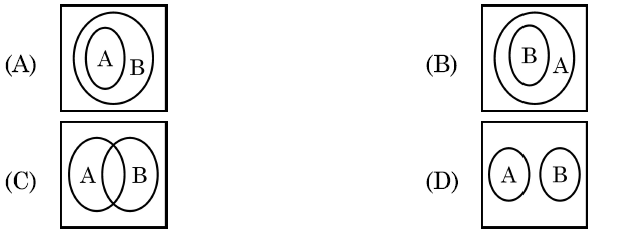 If A denotes the set of continuous functions and B denotes set of differentiable functions, then which of the following depicts the correct relation between set A and B ?
(A) A
(B) B
(C) C
(D) D
Key: B
Sol:
Sol:
Every differentiable function is continuous
#597
Mathematics
Continuity and Differentiability
MCQ_SINGLE
APPLY
2025
AISSCE(Board Exam)
KNOWLEDGE
1 Marks
If \(f(x)=\begin{cases}3x-2,&0 \lt x\le 1\\ 2x^{2}+ax,&1\lt x\lt 2\end{cases}\) is continuous for \(x\in(0,2)\), then a is equal to:
(A) -4
(B) \(-\frac{7}{2}\)
(C) -2
(D) -1
Key: D
Sol:
Sol:
...
#596
Mathematics
Continuity and Differentiability
MCQ_SINGLE
UNDERSTAND
2025
AISSCE(Board Exam)
KNOWLEDGE
1 Marks
The function f defined by \(f(x)=\begin{cases}x,&if~x\le1\\ 5,&if~x>1\end{cases}\) is not continuous at:
(A) \(x=0\)
(B) \(x=1\)
(C) \(x=2\)
(D) \(x=5\)
Key: B
Sol:
Sol:
for x=1, LHL=1 and RHL=5
#595
Mathematics
Continuity and Differentiability
MCQ_SINGLE
APPLY
2025
AISSCE(Board Exam)
KNOWLEDGE
1 Marks
If \(f(x)=\begin{cases}\frac{\sin^{2}ax}{x^{2}},&x\ne0\\ 1,&x=0\end{cases}\) is continuous at \(x=0\), then the value of a is:
(A) 1
(B) -1
(C) \(\pm1\)
(D) 0
Key:
Sol:
Sol:
#594
Mathematics
Continuity and Differentiability
MCQ_SINGLE
APPLY
2025
AISSCE(Board Exam)
KNOWLEDGE
1 Marks
If \(f(x)=\{[x],x\in R\}\) is the greatest integer function, then the correct statement is:
(A) f is continuous but not differentiable at \(x=2\).
(B) f is neither continuous nor differentiable at \(x=2\).
(C) f is continuous as well as differentiable at \(x=2\).
(D) f is not continuous but differentiable at \(x=2\).
Key:
Sol:
Sol:
#593
Mathematics
Continuity and Differentiability
MCQ_SINGLE
UNDERSTAND
2025
AISSCE(Board Exam)
Competency
1 Marks
If \(f(x)=\begin{cases}\frac{\log(1+ax)+\log(1-bx)}{x},&for~x\ne0\\ k&,for~x=0\end{cases}\) is continuous at \(x=0\), then the value of k is:
(A) a
(B) \(a+b\)
(C) \(a-b\)
(D) b
Key: C
Sol:
Sol: