Available Questions 64 found Page 1 of 4
Standalone Questions
#1849
Mathematics
Differential Equations
MCQ_SINGLE
ANALYZE
2026
AISSCE(Board Exam)
Competency
1 Marks
The order and degree of the differential equation $\frac{d}{dx}(e^y) = 0$ respectively are
(A) 0, 1
(B) 1, 1
(C) 2, 1
(D) 1, not defined
Key: B
Sol:
Sol:
#1848
Mathematics
Differential Equations
MCQ_SINGLE
APPLY
2026
AISSCE(Board Exam)
KNOWLEDGE
1 Marks
The integrating factor of differential equation $R\frac{dx}{dy} + Px = Q$ where P, Q, R are functions of y is
(A) $e^{\int\frac{P}{Q}dy}$
(B) $e^{\int Pdy}$
(C) $e^{\int\frac{P}{R}dy}$
(D) $e^{\int\frac{P}{R}dx}$
Key: C
Sol:
Sol:
#1833
Mathematics
Differential Equations
LA
APPLY
2026
AISSCE(Board Exam)
KNOWLEDGE
5 Marks
If $x = \cos t, y = \cos mt$, prove that $\left(1-x^2\right) \frac{d^2y}{dx^2} - x \frac{dy}{dx} + m^2y = 0$.
Key:
Sol:
Sol:
#1822
Mathematics
Differential Equations
LA
APPLY
2026
AISSCE(Board Exam)
Competency
5 Marks
Find the general solution of the differential equation $(x^{3}-3xy^{2})dx=(y^{3}-3x^{2}y)dy$.
Key:
Sol:
Sol:
#1821
Mathematics
Differential Equations
LA
APPLY
2026
AISSCE(Board Exam)
Competency
5 Marks
Solve the differential equation $y~e^{y}dx = (y^{3} + 2x~e^{y}) dy$, when $y(0)=1$.
Key:
Sol:
Sol:
#1792
Mathematics
Differential Equations
SA
2026
AISSCE(Board Exam)
KNOWLEDGE
3 Marks
Solve the differential equation $(x+2y^{3})dy=y~dx$.
Key:
Sol:
Sol:
#1791
Mathematics
Differential Equations
SA
2026
AISSCE(Board Exam)
KNOWLEDGE
3 Marks
Find a particular solution of the differential equation $(x+1)\frac{dy}{dx}=2 e^{-y}-1$ given that $y=0$ when $x=0$.
Key:
Sol:
Sol:
#1790
Mathematics
Differential Equations
SA
2026
AISSCE(Board Exam)
KNOWLEDGE
3 Marks
Find the general solution of the differential equation $2x^{2}\frac{dy}{dx}=y^{2}+2xy.$
Key:
Sol:
Sol:
#1789
Mathematics
Differential Equations
SA
2026
AISSCE(Board Exam)
KNOWLEDGE
3 Marks
Find the general solution of the differential equation: $y\log y\frac{dx}{dy}+x=\frac{2}{y}$
Key:
Sol:
Sol:
#1788
Mathematics
Differential Equations
SA
2026
AISSCE(Board Exam)
KNOWLEDGE
3 Marks
Solve the following differential equation: $x\frac{dy}{dx}=y-x\sin^{2}(\frac{y}{x})$ given that $y(1)=\frac{\pi}{6}$
Key:
Sol:
Sol:
#1720
Mathematics
Differential Equations
MCQ_SINGLE
APPLY
2026
AISSCE(Board Exam)
KNOWLEDGE
1 Marks
The order and degree of the differential equation $1+(\frac{d^{3}y}{dx^{3}})^{3}=\lambda\frac{d^{2}y}{dx^{2}}$ is:
(A) Order = 3, Degree = 3
(B) Order = 2, Degree = 2
(C) Order = 3, Degree = 1
(D) Order = 2, Degree = 1
Key: A
Sol:
Sol:
#1719
Mathematics
Differential Equations
MCQ_SINGLE
APPLY
2026
AISSCE(Board Exam)
Competency
1 Marks
$\frac{dy}{dx}=F(x,y)$ will be a homogeneous differential equation for which of the following functions? (i) $F(x,y)=3x+2y$ (ii) $F(x,y)=\sin\frac{y}{x}+\log y-\log x$ (iii) $F(x,y)=e^{y/x}+1$ (iv) $F(x,y)=\sqrt{x^{2}+y^{2}}-y$
(A) (i) and (ii)
(B) (i), (ii) and (iii)
(C) (ii), (iii) and (iv)
(D) (ii) and (iii)
Key: D
Sol:
Sol:
#1718
Mathematics
Differential Equations
MCQ_SINGLE
APPLY
2026
AISSCE(Board Exam)
Competency
1 Marks
Which of the following is not a Linear Differential Equation?
(A) $(1+x^{2})dy+2xy~dx=\cot x~dx$
(B) $y+\frac{d}{dx}(xy)=x(\sin x+\log x)$
(C) $x(1+y^{2})dx-y(1+x^{2})dy=0$
(D) $y~dx-(x+3y^{2})dy=0$
Key: C
Sol:
Sol:
#1717
Mathematics
Differential Equations
MCQ_SINGLE
APPLY
2026
AISSCE(Board Exam)
KNOWLEDGE
1 Marks
The general solution for the differential equation $\frac{dy}{dx}=e^{3x-y}$ is:
(A) $3e^{y}=e^{3x}+C$
(B) $\log(3x-y)=C$
(C) $e^{3x-y}=C$
(D) $-e^{y}+3e^{3x}=C$
Key: A
Sol:
Sol:
#1716
Mathematics
Differential Equations
MCQ_SINGLE
APPLY
2026
AISSCE(Board Exam)
Competency
1 Marks
The integrating factor of the differential equation $2x\frac{dy}{dx}-y=3$ is
(A) $\sqrt{x}$
(B) $\frac{1}{\sqrt{x}}$
(C) $e^{x}$
(D) $e^{-x}$
Key: B
Sol:
Sol:
#1715
Mathematics
Differential Equations
MCQ_SINGLE
APPLY
2026
AISSCE(Board Exam)
Competency
1 Marks
The general solution of the differential equation $\frac{dy}{dx}=\frac{\sqrt{y}}{\sqrt{x}}$ is
(A) $\log\sqrt{y}=\log\sqrt{x}+C$
(B) $\sqrt{y}+\sqrt{x}=C$
(C) $\sqrt{y}-\sqrt{x}=C$
(D) $\log\sqrt{y}+\log\sqrt{x}=C$
Key: C
Sol:
Sol:
#1714
Mathematics
Differential Equations
MCQ_SINGLE
APPLY
2026
AISSCE(Board Exam)
Competency
1 Marks
Product of the order and degree of differential equation $1+(\frac{dy}{dx})^{3}=\lambda(\frac{d^{3}y}{dx^{3}})^{2}$ is:
(A) 5
(B) 6
(C) 2
(D) 3
Key: B
Sol:
Sol:
#1506
Mathematics
Differential Equations
SA
APPLY
2026
AISSCE(Board Exam)
Competency
3 Marks
Find the particular solution of the differential equation $x\frac{dy}{dx}=(x+2)(y+2)$, given that $y(1)=-1$.
Key:
Sol:
Sol:
#1505
Mathematics
Differential Equations
SA
APPLY
2026
AISSCE(Board Exam)
Competency
3 Marks
Find the general solution of the following differential equation: $x^{2}\frac{dy}{dx}=x^{2}+xy+y^{2}$.
Key:
Sol:
Sol:
#1493
Mathematics
Differential Equations
MCQ_SINGLE
REMEMBER
2026
AISSCE(Board Exam)
KNOWLEDGE
1 Marks
The general solution for the differential equation $\frac{dy}{dx} = e^{3x-y}$ is
(A) $3e^y = e^{3x} + C$
(B) $\log (3x - y) = C$
(C) $e^{3x-y} = C$
(D) $-e^y + 3e^{3x} = C$
Key: A
Sol:
Sol:
Case-Based Questions
CASE ID: #115
Cl: CBSE Class 12
Mathematics
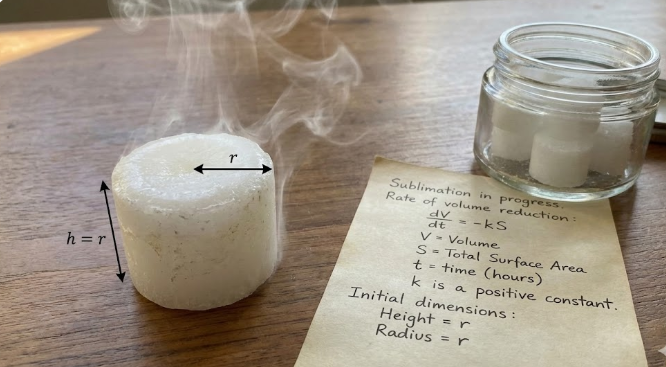
Camphor is a waxy, colourless solid with strong aroma that evaporates through the process of sublimation, if left in the open at room temperature.
A cylindrical camphor tablet whose height is equal to its radius (r) evaporates when exposed to air such that that the rate of reduction of its volume is proportional to its total surface area. Thus, $\frac{dV}{dt} = kS$ is the differential equation, where V is the volume, S is the surface area and t is the time in hours.
SUBJECTIVE
REMEMBER
2025
AISSCE(Board Exam)
Competency
1 Marks
(i) Write the order and degree of the given differential equation.
(ii) Substituting $V = \pi r^3$ and $S = 2\pi r^2$, we get the differential equation $\frac{dr}{dt} = \frac{2}{3}k$. Solve it, given that $r(0) = 5$ mm.
(iii) (a) If it is given that $r = 3$ mm when $t = 1$ hour, find the value of k. Hence, find t for $r = 0$ mm.
OR
(iii) (b) If it is given that $r = 1$ mm when $t = 1$ hour, find the value of k. Hence, find t for $r = 0$ mm.
(ii) Substituting $V = \pi r^3$ and $S = 2\pi r^2$, we get the differential equation $\frac{dr}{dt} = \frac{2}{3}k$. Solve it, given that $r(0) = 5$ mm.
(iii) (a) If it is given that $r = 3$ mm when $t = 1$ hour, find the value of k. Hence, find t for $r = 0$ mm.
OR
(iii) (b) If it is given that $r = 1$ mm when $t = 1$ hour, find the value of k. Hence, find t for $r = 0$ mm.
Key:
Sol:
Sol: