Available Questions 40 found Page 1 of 2
Standalone Questions
#1500
Mathematics
Inverse Trigonometric Functions
VSA
REMEMBER
2026
AISSCE(Board Exam)
KNOWLEDGE
2 Marks
$\text{Evaluate: }\tan\!\left(\sin^{-1}1-\cos^{-1}\!\left(-\frac{1}{2}\right)\right).$
Key:
Sol:
Sol:
#1499
Mathematics
Inverse Trigonometric Functions
VSA
REMEMBER
2026
AISSCE(Board Exam)
KNOWLEDGE
2 Marks
$\text{Simplify: }\tan^{-1}\!\left(\frac{\cos 2x-\sin 2x}{\cos 2x+\sin 2x}\right),\quad 0<x<\frac{\pi}{4}.$
Key:
Sol:
Sol:
#1490
Mathematics
Inverse Trigonometric Functions
MCQ_SINGLE
UNDERSTAND
2026
AISSCE(Board Exam)65/1/1
KNOWLEDGE
1 Marks
If $2 \cos^{-1} x = y$, then
(A) $0 \leq y \leq \pi$
(B) $-\pi \leq y \leq \pi$
(C) $0 \leq y \leq 2\pi$
(D) $-\pi \leq y \leq 0$
Key: C
Sol:
Sol:
#1443
Mathematics
Inverse Trigonometric Functions
VSA
UNDERSTAND
2025
AISSCE(Board Exam)
KNOWLEDGE
2 Marks
Find the domain of $f(x)=\sin^{-1}(-x^{2})$.
Key:
Sol:
Sol:
#1421
Mathematics
Inverse Trigonometric Functions
VSA
UNDERSTAND
2025
AISSCE(Board Exam)
KNOWLEDGE
2 Marks
Find the domain of the function $f(x)=\cos^{-1}(x^{2}-4)$.
Key:
Sol:
Sol:
#1403
Mathematics
Inverse Trigonometric Functions
VSA
UNDERSTAND
2025
AISSCE(Board Exam)
KNOWLEDGE
2 Marks
Find domain of $\sin^{-1}\sqrt{x-1}$.
Key:
Sol:
Sol:
#1402
Mathematics
Inverse Trigonometric Functions
VSA
UNDERSTAND
2025
AISSCE(Board Exam)
KNOWLEDGE
2 Marks
Simplify $\sin^{-1}\left(\frac{x}{\sqrt{1+x^{2}}}\right)$.
Key:
Sol:
Sol:
#1357
Mathematics
Inverse Trigonometric Functions
VSA
UNDERSTAND
2025
AISSCE(Board Exam)
KNOWLEDGE
2 Marks
Evaluate: $\tan^{-1}\left[2\sin\left(2\cos^{-1}\frac{\sqrt{3}}{2}\right)\right]$.
Key:
Sol:
Sol:
#1333
Mathematics
Inverse Trigonometric Functions
VSA
REMEMBER
2024
AISSCE(Board Exam)
KNOWLEDGE
2 Marks
Find value of k if $sin^{-1}[k~tan(2~cos^{-1}\frac{\sqrt{3}}{2})]=\frac{\pi}{3}.$
Key:
Sol:
Sol:
#1311
Mathematics
Inverse Trigonometric Functions
VSA
REMEMBER
2024
AISSCE(Board Exam)
KNOWLEDGE
2 Marks
Find the principal value of $tan^{-1}(1)+cos^{-1}(-\frac{1}{2})+sin^{-1}(-\frac{1}{\sqrt{2}})$
Key:
Sol:
Sol:
#1310
Mathematics
Inverse Trigonometric Functions
VSA
UNDERSTAND
2024
AISSCE(Board Exam)
KNOWLEDGE
2 Marks
Express $tan^{-1}(\frac{cos~x}{1-sin~x})$ where $\frac{-\pi}{2}<x<\frac{\pi}{2}$ in the simplest form.
Key:
Sol:
Sol:
#1267
Mathematics
Inverse Trigonometric Functions
VSA
APPLY
2024
AISSCE(Board Exam)
KNOWLEDGE
2 Marks
Find the domain of the function $f(x)=sin^{-1}(x^{2}-4).$ Also, find its range.
Key:
Sol:
Sol:
#1266
Mathematics
Inverse Trigonometric Functions
VSA
UNDERSTAND
2024
AISSCE(Board Exam)
KNOWLEDGE
2 Marks
Find the value of $tan^{-1}(-\frac{1}{\sqrt{3}})+cot^{-1}(\frac{1}{\sqrt{3}})+tan^{-1}[sin(-\frac{\pi}{2})]$
Key:
Sol:
Sol:
#1244
Mathematics
Inverse Trigonometric Functions
VSA
APPLY
2024
AISSCE(Board Exam)
KNOWLEDGE
2 Marks
Evaluate : $sec^{2}(tan^{-1}\frac{1}{2})+cosec^{2}(cot^{-1}\frac{1}{3})$
Key:
Sol:
Sol:
#975
Mathematics
Inverse Trigonometric Functions
ASSERTION_REASON
REMEMBER
2025
AISSCE(Board Exam)
Competency
1 Marks
Assertion (A) : Set of values of $\sec^{-1}\left(\frac{\sqrt{3}}{2}\right)$ is a null set.
Reason (R) : $\sec^{-1}$ x is defined for $x \in \mathbb{R}-(-1, 1)$.
Key: A
Sol:
Sol:
#969
Mathematics
Inverse Trigonometric Functions
MCQ_SINGLE
REMEMBER
2025
AISSCE(Board Exam)
KNOWLEDGE
1 Marks
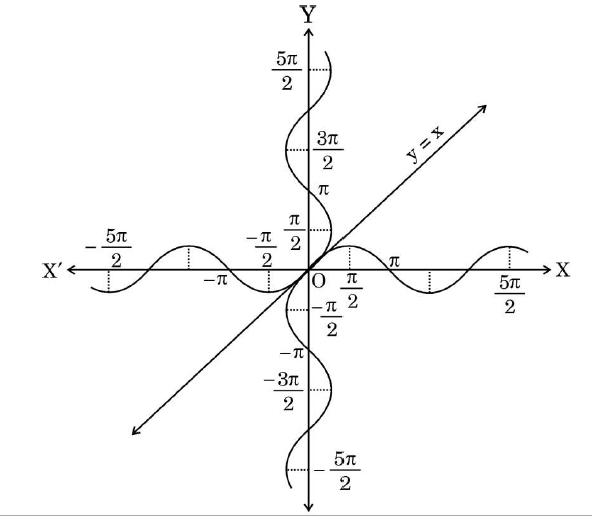 The following graph is a combination of :
 (A) $y = \sin^{-1} x$ and $y = \cos^{-1} x$
(B) $y = \cos^{-1} x$ and $y = \cos x$
(C) $y = \sin^{-1} x$ and $y = \sin x$
(D) $y = \cos^{-1} x$ and $y = \sin x$
Key: C
Sol:
Sol:
#968
Mathematics
Inverse Trigonometric Functions
MCQ_SINGLE
ANALYZE
2025
AISSCE(Board Exam)
Competency
1 Marks
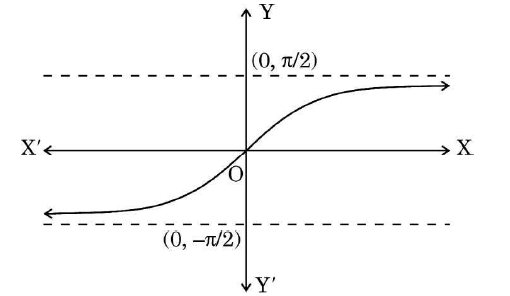 The given graph illustrates :
 (A) $y = \tan^{-1}x$
(B) $y = \csc^{-1}x$
(C) $y = \cot^{-1}x$
(D) $y = \sec^{-1}x$
Key: A
Sol:
Sol:
#945
Mathematics
Inverse Trigonometric Functions
VSA
APPLY
2024
KNOWLEDGE
2 Marks
Express \(\tan^{-1}(\frac{\cos~x}{1-\sin~x})\) where \(\frac{-\pi}{2}\lt x\lt \frac{\pi}{2}\) in the simplest form.
Key:
Sol:
Sol:
Let $y = \tan^{-1}\left(\frac{\cos x}{1-\sin x}\right)$.First, use half-angle identities to rewrite the numerator and denominator:$$\cos x = \cos^2\frac{x}{2} - \sin^2\frac{x}{2} = \left(\cos\frac{x}{2} - \sin\frac{x}{2}\right)\left(\cos\frac{x}{2} + \sin\frac{x}{2}\right)$$$$1 - \sin x = \cos^2\frac{x}{2} + \sin^2\frac{x}{2} - 2\sin\frac{x}{2}\cos\frac{x}{2} = \left(\cos\frac{x}{2} - \sin\frac{x}{2}\right)^2$$Substitute these back into the expression:$$\frac{\cos x}{1-\sin x} = \frac{\left(\cos\frac{x}{2} - \sin\frac{x}{2}\right)\left(\cos\frac{x}{2} + \sin\frac{x}{2}\right)}{\left(\cos\frac{x}{2} - \sin\frac{x}{2}\right)^2}$$Cancel the common term $\left(\cos\frac{x}{2} - \sin\frac{x}{2}\right)$:$$= \frac{\cos\frac{x}{2} + \sin\frac{x}{2}}{\cos\frac{x}{2} - \sin\frac{x}{2}}$$Divide the numerator and denominator by $\cos\frac{x}{2}$:$$= \frac{1 + \tan\frac{x}{2}}{1 - \tan\frac{x}{2}}$$Since $\tan\frac{\pi}{4} = 1$, we can rewrite this as:$$= \frac{\tan\frac{\pi}{4} + \tan\frac{x}{2}}{1 - \tan\frac{\pi}{4}\tan\frac{x}{2}}$$Using the identity $\tan(A+B) = \frac{\tan A + \tan B}{1 - \tan A \tan B}$:$$= \tan\left(\frac{\pi}{4} + \frac{x}{2}\right)$$Therefore:$$y = \tan^{-1}\left(\tan\left(\frac{\pi}{4} + \frac{x}{2}\right)\right)$$Since $x \in (-\frac{\pi}{2}, \frac{\pi}{2})$, the angle lies within the principal range, so:$$y = \frac{\pi}{4} + \frac{x}{2}$$
#944
Mathematics
Inverse Trigonometric Functions
VSA
APPLY
2024
KNOWLEDGE
2 Marks
Find the value of \(\tan^{-1}(-\frac{1}{\sqrt{3}})+\cot^{-1}(\frac{1}{\sqrt{3}})+\tan^{-1}[\sin(-\frac{\pi}{2})].\)
Key:
Sol:
Sol:
Let the given expression be $E$.$$E = \tan^{-1}\left(-\frac{1}{\sqrt{3}}\right) + \cot^{-1}\left(\frac{1}{\sqrt{3}}\right) + \tan^{-1}\left[\sin\left(-\frac{\pi}{2}\right)\right]$$Evaluate each term separately using principal values:$\tan^{-1}\left(-\frac{1}{\sqrt{3}}\right) = -\frac{\pi}{6}$(Since $\tan\frac{\pi}{6} = \frac{1}{\sqrt{3}}$ and $\tan^{-1}(-x) = -\tan^{-1}x$)$\cot^{-1}\left(\frac{1}{\sqrt{3}}\right) = \frac{\pi}{3}$(Since $\cot\frac{\pi}{3} = \frac{1}{\sqrt{3}}$)For the third term, first evaluate the sine function:$\sin\left(-\frac{\pi}{2}\right) = -1$So, $\tan^{-1}(-1) = -\frac{\pi}{4}$Substitute these values back into the expression:$$E = -\frac{\pi}{6} + \frac{\pi}{3} - \frac{\pi}{4}$$Find a common denominator (which is 12):$$E = \frac{-2\pi + 4\pi - 3\pi}{12}$$$$E = \frac{-\pi}{12}$$
#943
Mathematics
Inverse Trigonometric Functions
VSA
APPLY
2024
KNOWLEDGE
2 Marks
Find the domain of the function \(f(x)=\sin^{-1}(x^{2}-4).\) Also, find its range.
Key:
Sol:
Sol:
Domain
We need the argument of the arcsine to be in $[-1, 1]$:$$-1 \le x^2 - 4 \le 1$$Add 4 to all parts:$$3 \le x^2 \le 5$$Taking the square root, we get two intervals:$$\sqrt{3} \le |x| \le \sqrt{5}$$This splits into positive and negative regions:$$x \in [-\sqrt{5}, -\sqrt{3}] \cup [\sqrt{3}, \sqrt{5}]$$
Range
From the inequality above, we know that as $x$ varies over the domain, the term $(x^2 - 4)$ covers the entire interval $[-1, 1]$.Therefore, $f(x)$ covers all possible values of $\sin^{-1}(u)$:$$y \in \left[-\frac{\pi}{2}, \frac{\pi}{2}\right]$$